POSITIONS IN ASTROLOGY THAT FACE BIAS:
THE EXAMPLE OF THE MOON IN SCORPIO
Astrology, based on the premise that celestial movements correspond with events and conditions on Earth, can be understood as a symbolic guide for the integration and transformation of personality. Within this framework, planets are not regarded as transmitters of physical influences, but as representations of human functions. It is often suggested that each individual is born at a specific time and place in response to a need of the Universe, and that this need is reflected in the birth chart, which reveals the individual’s unique developmental path. Therefore, the fundamental question is not what will happen, but what the meaning of what is happening might be. This is because external events are interwoven with our own psychological processes.
From this perspective, several questions arise. If outer experiences are connected to inner dynamics, can changes within transform what manifests externally? If we gain insight into our internal conflicts, can challenges become opportunities? If the birth chart functions as a symbolic map of the psyche, can it help us recognize choices that support our evolution? And if we confront denied aspects of ourselves, can we plan our next steps more consciously?
Because my answer to these questions is affirmative, I position myself against rigidly fatalistic interpretations of astrology. I do not consider the birth chart merely the product of external forces; rather, I view it as possessing an inherent tendency toward wholeness. Since I understand astrology as a tool that supports the psyche’s process of self-realization, I see it as fluid and dynamic. This does not deny that individuals are born with a certain archetypal structure; rather, it emphasizes our capacity to shape how that structure is expressed. For this reason, I believe we must move beyond statements such as “this is the definitive meaning of a Mars–Saturn square,” and instead adopt a contextual approach: “this is how a Mars–Saturn square may manifest in this chart at this moment.” When we recognize that human beings are subject to development and evolution, we understand that the same configuration may represent different possibilities over time. Astrology then becomes not a fixed determinant, but a symbolic key that reveals our potential for transformation.
Let me illustrate this through my own chart.
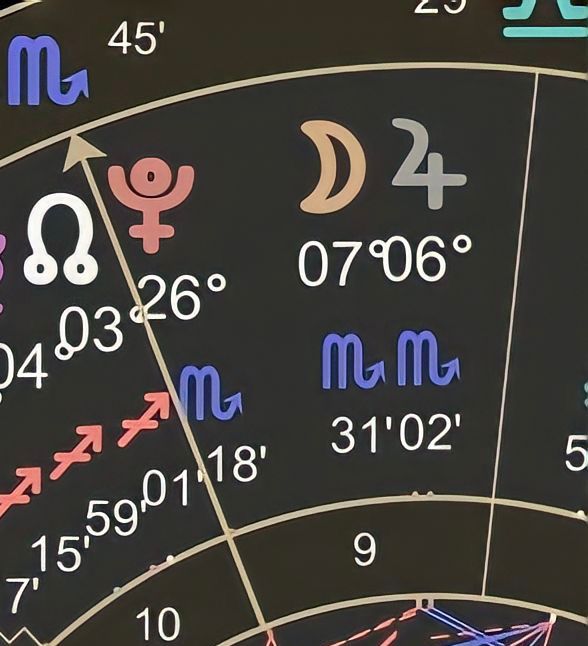
The Moon is located on the fixed star Khambalia, in Scorpio — where it is traditionally considered in fall — and in the balsamic phase, also known as the waning phase. In other words, it appears to meet many criteria that might invite interpretive bias.
The Moon in a chart generally symbolizes the mother, the past, the unconscious, habits, automatic responses, comfort zones, emotional processes, instinctual tendencies, and sources of nourishment. A Scorpio Moon often associates emotional life with themes of risk and taboo, which can lead to the suppression of feelings. A person who experiences emotions as potentially overwhelming may seek hidden truths in order to maintain psychological control. Knowing what lies beneath appearances becomes a path toward emotional security. This drive to penetrate mysteries may originate in an early relationship with the mother that felt enigmatic or unpredictable, producing an initial perception of the world as suspicious or unsafe. Feeling instinctively endangered, the individual may engage in power struggles and attempts at control. Such vigilance can generate recurring crises, and because the Moon also relates to comfort patterns, the person may unconsciously derive familiarity from intensity or crisis itself.
However, this seemingly difficult picture can also be viewed differently. A person who struggles with trust may work to purify and transform their emotional depths in order to feel secure. They may develop resilience, willpower, and the capacity to endure crises while remaining focused on goals. Scorpio’s greatest strength lies in its familiarity with endings and renewal; having symbolically “died” many times, it can accept transformation as part of life. If the individual believes that renewal follows loss, they may channel their energy with determination. This psychological orientation can produce profound insight, making the individual naturally inclined toward psychotherapy, research, investigation, or esoteric inquiry. Yet these potentials are not uniform. Some individuals may become trapped in suspicion or obsession, while others achieve deep transformation — and many may experience both at different times.
The same interpretive flexibility applies to the lunar phase. The balsamic phase covers the final days before the New Moon, symbolizing closure rather than initiation. Like the waning Moon, its vitality is lower, and individuals born under this phase may require greater sensitivity to energy management. At the same time, balsamic types often possess intuitive awareness of future trends and strong capacities for release. They may instinctively clear outdated patterns. Their path may incline either toward self-sacrifice and victimhood, or toward spiritual dedication and universal ideals. While physical energy may fluctuate, mental and imaginative sensitivity can be profound. Through dreams, poetry, and symbolic perception, they may access deep inner knowledge. Melancholy or escapism is possible, yet so are storytelling, healing, and spiritual insight. Once again, the outcome depends largely on how the individual engages with these tendencies.
If we approach a Scorpio Moon in the balsamic phase with bias and produce automatic, one-dimensional interpretations, we risk limiting the individual’s potential. In reality, such a configuration may contain powerful transformative capacity — materially and spiritually — because the deeper the descent, the greater the potential rebound. Rather than defining the person solely through their archetypal structure, discussing how they might work with that structure opens new possibilities. Yet we must also acknowledge the inherent nature of that structure. Its expression is shaped by house placement and planetary aspects.
For example, my Moon is located in the ninth house and conjunct Jupiter, which naturally inclines me toward themes associated with Sagittarius: education, philosophy, belief systems, cultures, and exploration. I seek growth through knowledge and long journeys, both literal and symbolic. With a Sagittarius stellium, travel and exposure to different worldviews have become integral parts of my development.
If the ninth house is where my Scorpio Moon manifests, then themes of crisis, transformation, and depth will also emerge there. This could involve exploring hidden belief systems, joining philosophical or esoteric groups, or developing intuitive insight. Conversely, it could involve instability in worldview, vulnerability to manipulation, or ideological conflict. Which possibility becomes activated? This is precisely where the astrologer’s role emerges: not to assign a fixed meaning, but to identify potentials that resonate with the individual’s current developmental path.
The same Moon in Scorpio could have been located in the second house, where themes of material security and self-worth dominate. In that context, emotional attachment to possessions, financial decision-making, or family support dynamics might become central. One individual might achieve financial empowerment, while another might struggle with compulsive spending or debt. A narrow interpretation would obscure this range of possibilities.
What I am proposing can be summarized in four points:
• Individuals are born with certain archetypal structures, yet they possess agency in how those structures are expressed.
• A birth chart does not promise a single outcome; it reveals multiple potentials. The astrologer’s task is to recognize those that serve the individual’s current path.
• Challenging placements or aspects often serve evolutionary growth and may lead to breakthroughs when consciously integrated.
• Perceived “negative” factors may become strengths, while perceived “positive” ones may become limitations, depending on their use.
Astrology is therefore not about changing a person’s essential nature, but about transforming life dynamics through the conscious use of that nature. A Scorpio Moon cannot be turned into a Taurus or Cancer Moon. Emotional nourishment, instinctual responses, and psychological orientation remain fundamentally distinct. A Moon in Scorpio on Khambalia will naturally gravitate toward depth, mystery, shadow, and symbolic exploration. These inclinations are part of identity itself and should not be suppressed.
Such individuals will inevitably encounter intense inner experiences. Yet if they move beyond crisis toward integration, they also access Scorpio’s strength, determination, and regenerative power. The way the archetype is activated shapes both inner and outer life momentum. Instead of focusing excessively on what one’s nature is, it becomes more productive to explore how that nature can be used and for what purpose. In other words, the question is not which ingredients we possess, but what we choose to create with them.
Thus, we move from the mindset of “this is the meaning of Moon in Scorpio” to “this is the meaning of Moon in Scorpio in this chart, at this moment.” Even if archetypal structures remain constant, their expression can evolve. We interpret the future not through a single possibility, but through possibilities — discovering paths that align with development. If what is below reflects what is above, then we recognize our capacity to participate consciously in the movement of the wheel.
With love.


Copyright 2022 © All Rights Reserved Webartuar